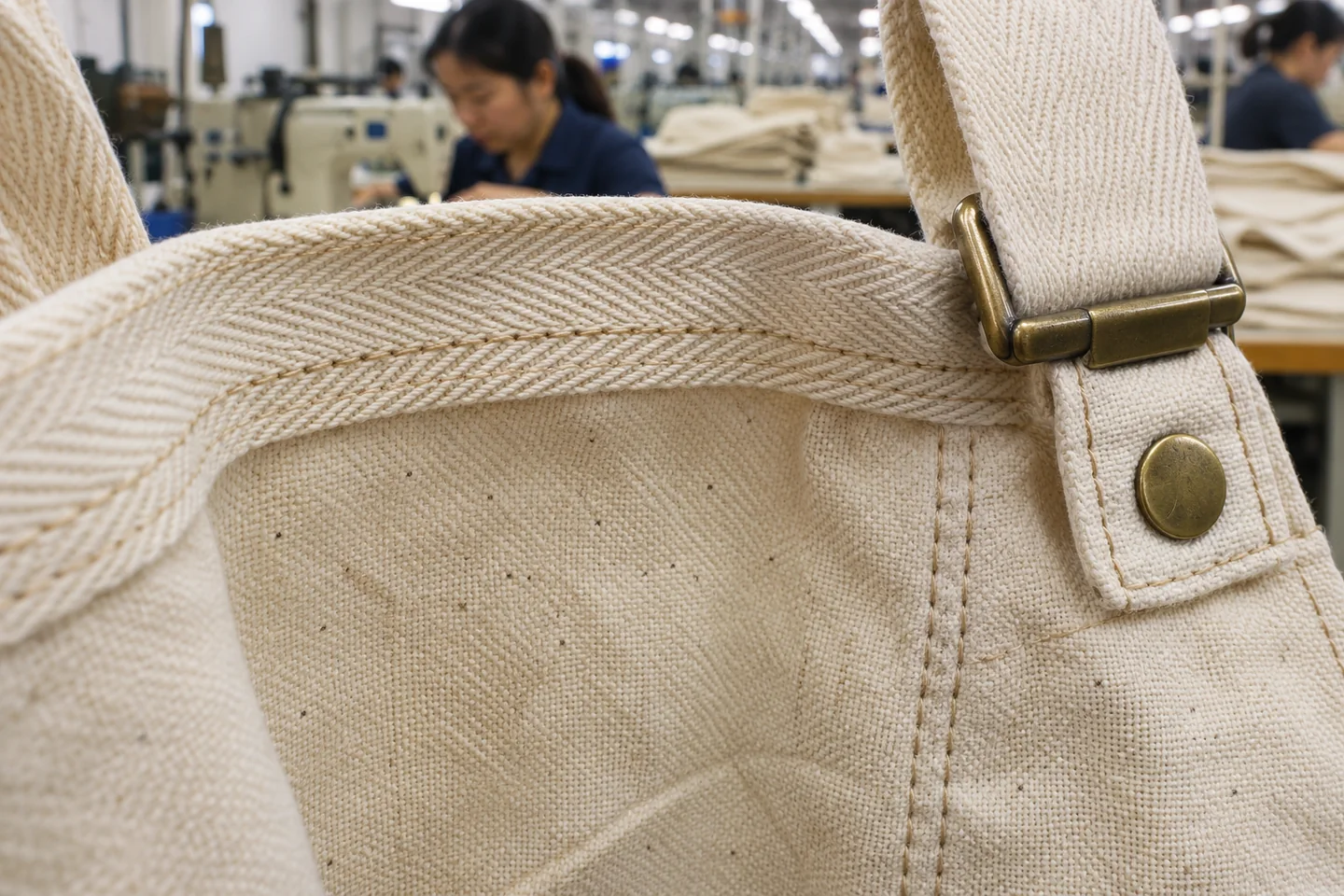
Heavyweight canvas workwear aprons built for daily trade use, with OEM customisation, certified materials and factory-controlled quality.
For tailored OEM specifications and direct mill quotations, explore Custom Heavyweight Canvas & Workwear Aprons Custom OEM Factory.
Why custom men's aprons need a heavier build
A work apron is not a kitchen accessory. For butchers, baristas, welders, woodworkers, brewers and workshop teams, it is daily protective equipment that takes heat, sparks, sharp edges, hot liquid and repeated washing. Lightweight fashion aprons fail at the pocket seam, the neck strap and the waist tie first. A heavyweight canvas apron, cut for a male frame and reinforced where work actually happens, lasts longer, fits better and looks more professional on the floor. This guide explains what buyers should specify, check and approve before placing a bulk order.
Heavyweight canvas: what the numbers actually mean
Canvas weight decides drape, durability and comfort. A 12 oz (340 GSM) canvas is a practical starting point for café and retail work, while 16 oz (450 GSM) suits butchery, metalwork and joinery. At 20 oz (565 GSM) the apron stands up on its own and resists abrasion, but it needs a broken-in neck strap and a balanced cross-back design to stay comfortable through a long shift. VerveSupply works with 100% cotton canvas and cotton-poly blends, all dyed to Pantone TCX references and tested for colourfastness to washing at Grade 4 or above and to rubbing at Grade 4 dry and Grade 3-4 wet. Ask for the lab report, not a colour swatch alone, and check the fabric under your own lighting before approval.
Twill weave, 340–565 GSM, with a water-repellent or waxed finish on request. Shrinkage controlled to ±2% after three wash cycles at 40°C. OEKO-TEX Standard 100 certified base cloth; REACH-compliant dyes and finishes. Cut and fit for real work
A good apron should cover the chest, protect the thighs and leave the arms free. Standard sizes run 68 cm wide by 95 cm long, with a dimensional tolerance of ±5 mm on length and width and ±3 mm on pocket placement. The neck strap should adjust from 48 cm to 62 cm, and waist ties should reach at least 90 cm each side so the apron can be tied at the front or back. Cross-back straps distribute weight across the shoulders and reduce neck strain, while a split-leg or side-slit option improves movement for kneeling and ladder work.
| Specification | Standard | Tolerance / Test |
|---|---|---|
| Fabric weight | 12–20 oz canvas | 340–565 GSM, ±5% |
| Stitch density | 8–10 SPI, main seams | ±1 SPI; bartacks at stress points |
| Dimensions | 68 × 95 cm | ±5 mm; pockets ±3 mm |
| Colourfastness | Pantone TCX match | Wash Grade 4; rub Grade 4 / 3-4 |
| Inspection | AQL 2.5, Level II | Major defects 2.5; minor 4.0 |
Stitching is where most aprons fail. Specify 8–10 stitches per inch on main seams, 5 mm double-needle topstitching on pocket edges, and bartack reinforcement at every stress point: pocket corners, strap joins and tie attachments. Use bonded polyester core-spun thread, Tex 40 for general seams and Tex 60 for straps. Brass or gunmetal rivets at pocket corners add strength without snagging, and a double-layer chest pocket holds pens, a thermometer or a phone without sagging. For custom men's aprons ordered in volume, ask the factory to keep one approved sample sealed as the production reference.
Double-folded 12 mm hems, locked with chain stitching for wash stability. Reinforced waist ties, 2.5 cm wide, stitched through the apron body, not just the hem. Split kangaroo pocket with a 15 cm opening, plus a divided chest pocket. Optional leather or PU strap trims, D-ring, towel loop and pen slots. Customisation without weakening the apron
Branding should sit on a stable panel, never across a seam or bartack. Embroidery works best on the chest and upper pocket, with a density of 5,500–7,000 stitches for a standard chest logo and tear-away backing to prevent puckering. Screen printing suits large back prints and bold café marks, while a debossed leather patch adds a premium finish for barbershops, breweries and butchers. Pantone PMS references should be confirmed on the actual canvas, because the same ink looks darker on heavy twill than on paper. Work with Custom Heavyweight Canvas & Workwear Aprons Custom OEM Factory to lock artwork, placement, thread colours and print size before sampling, so the approved sample matches bulk production exactly.
Embroidery, screen print, heat transfer, woven label and leather patch. Custom sizes, strap systems, pocket layouts, colours and hardware finishes. Private-label woven tags, care labels and retail-ready packaging. What to approve before bulk production
Approve the fabric swatch, the size set, the stitch sample and the branded sample together. Check that the neck strap adjusts smoothly, the ties hold a knot, the pockets sit level and the logo remains clear after one wash. For custom men's aprons, confirm the fit on the intended wearers, not only on a mannequin, and record the approved measurements in the tech pack. Any change to fabric, thread, hardware or artwork after approval should trigger a new sample.
Quality control, certification and inspection
VerveSupply manufactures under BSCI-audited factory conditions, using OEKO-TEX Standard 100 certified materials and REACH-compliant dyes and finishes. Inline checks cover fabric shade, stitch density, seam strength and hardware fixing, followed by a final random inspection to AQL 2.5, General Inspection Level II. Major defects are limited to 2.5 and minor defects to 4.0, with a separate check for measurement, colour and branding. Buyers should receive a pre-shipment report, photos of the inspected cartons and the batch fabric test results before goods leave the factory.
Ordering from VerveSupply
The minimum order quantity is 100 pcs, with a 7-Day Sample and 18 Days Bulk lead time. Send your fabric weight, size, colour references, logo artwork and pocket requirements, and request a tailored factory quote via inquiry. A clear tech pack, an approved sample and a written inspection standard will keep delivery on schedule and make repeat orders faster, more consistent and easier to scale.